Ring-billed Gull Larus delawarensis 環嘴鷗
Category I. Accidental.
IDENTIFICATION
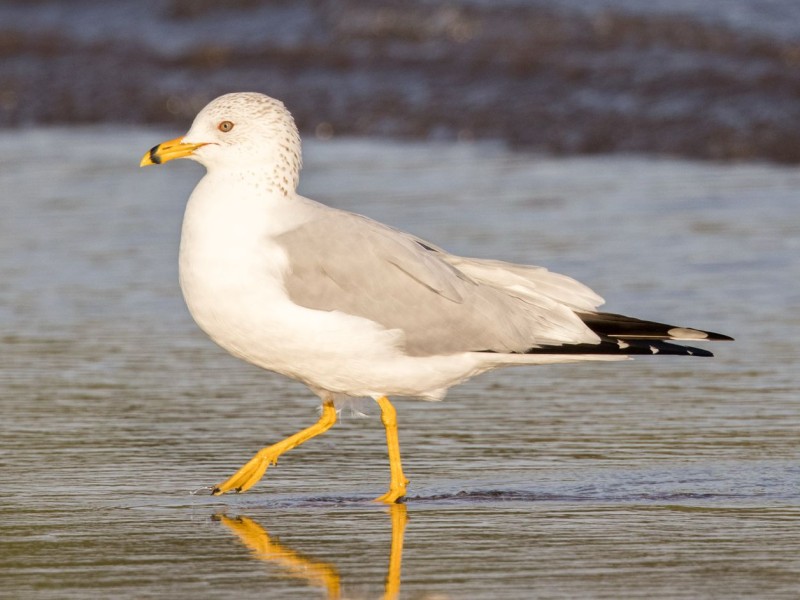
Feb. 2022, Mexico. Yann Muzika. Adult.
43-54 cm. Slightly larger than Common Gull. Plumage of adult is similar but upperparts are noticeably paler. In non-breeding plumage has fine streaks on head and neck. The legs and bill are yellow with a distinct black subterminal band on the latter, and the irides are obviously pale.
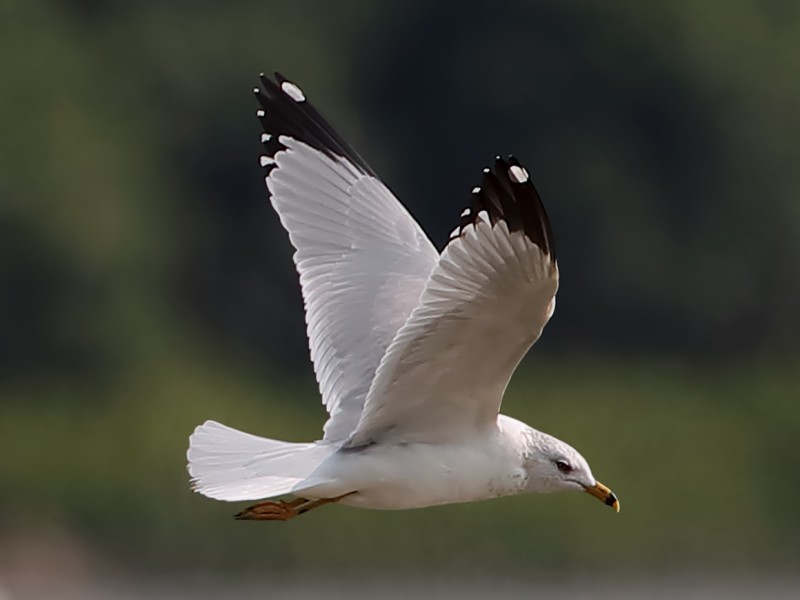
Mar. 2021, Michelle and Peter Wong. Adult.
The white subterminal spots on the outer 1-2 primaries are small and closer to the tip than on Common Gull, while the white trailing edge to the upperwings is less contrasting.
In first-winter plumage usually paler overall than Common Gull of the taxon kamtschatschensis and moult often produces a pale grey mantle (often with a few dark crescents) by early winter that can include the upperwing coverts.
In flight the upperwing pattern is more contrasting with blacker outer primaries and paler silvery-grey inner primaries and greater coverts.
VOCALISATIONS
Rather nasal and high-pitched.
DISTRIBUTION & HABITAT PREFERENCE
The sole record occurred in the intertidal area of Deep Bay near the Mai Po boardwalk hide.
OCCURRENCE
2021: An adult was present in the gull roost at Mai Po on 20 March (Lok 2025).
BEHAVIOUR, FORAGING & DIET
No observations.
RANGE & SYSTEMATICS
The breeding and wintering range lies largely in North America between 10oN and 60oN, but there are many records of vagrants and occasionally breeding birds in Europe (Pollet et al. 2020).
CONSERVATION STATUS
IUCN: Least Concern. Population trend increasing.
Pollet, I. L., D. Shutler, J. W. Chardine and J. P. Ryder (2020). Ring-billed Gull (Larus delawarensis), version 1.0. In Birds of the World (A. F. Poole, Editor). Cornell Lab of Ornithology, Ithaca, NY, USA. https://doi.org/10.2173/bow.ribgul.01
Lok, K. C. W. (2025). Ring-billed Gull Larus delawarensis in front of the Mai Po boardwalk. The first record for Hong Kong and the Chinese mainland. Hong Kong Bird Report 2021: 242-243.